Additive Manufacturing (AM) + 3D skeleton winding (3DSW)

Digitally Engineered. Additively Manufactured. Purpose-Built.

Motivation

Lightweight structures increasingly need to combine high mechanical performance, functional integration, and reduced environmental impact. Conventional metallic designs often limit lightweighting potential, while established composite approaches can restrict design freedom and increase manufacturing complexity.

The publicly funded confidentAM project, supported by the Federal Ministry for Economic Affairs and Climate Action (BMWK), builds on previous work with 3D Skeleton Winding (3DWS) and injection molding in the ACCORD project. The next development step was to combine 3DSW with additive manufacturing (AM), enabling tailored thermoplastic composite designs without capital investment in dedicated molds.

Simutence developed the virtual design and engineering approach behind the technology, including load-path-oriented design, structural optimization to exploit the lightweighting potential while meeting load requirements, and process simulation for the winding process.


Key takeaways

  • Mold-free AM + 3DSW manufacturing route for load-adapted thermoplastic composite structures.
  • Load-path-oriented virtual design workflow combining fiber skeleton definition, AM core optimization, and FEA validation.
  • Thermal winding simulation in SimuQuick with high prediction accuracy in validation trials.
  • Successful industrial demonstrators: modular gripper system and thermoplastic E-MTB damper rocker.
  • Up to 69% weight reduction and up to 20% lower CO2 footprint compared to reference designs.

Project Partners

Technology: Additive Manufacturing + 3D Skeleton Winding

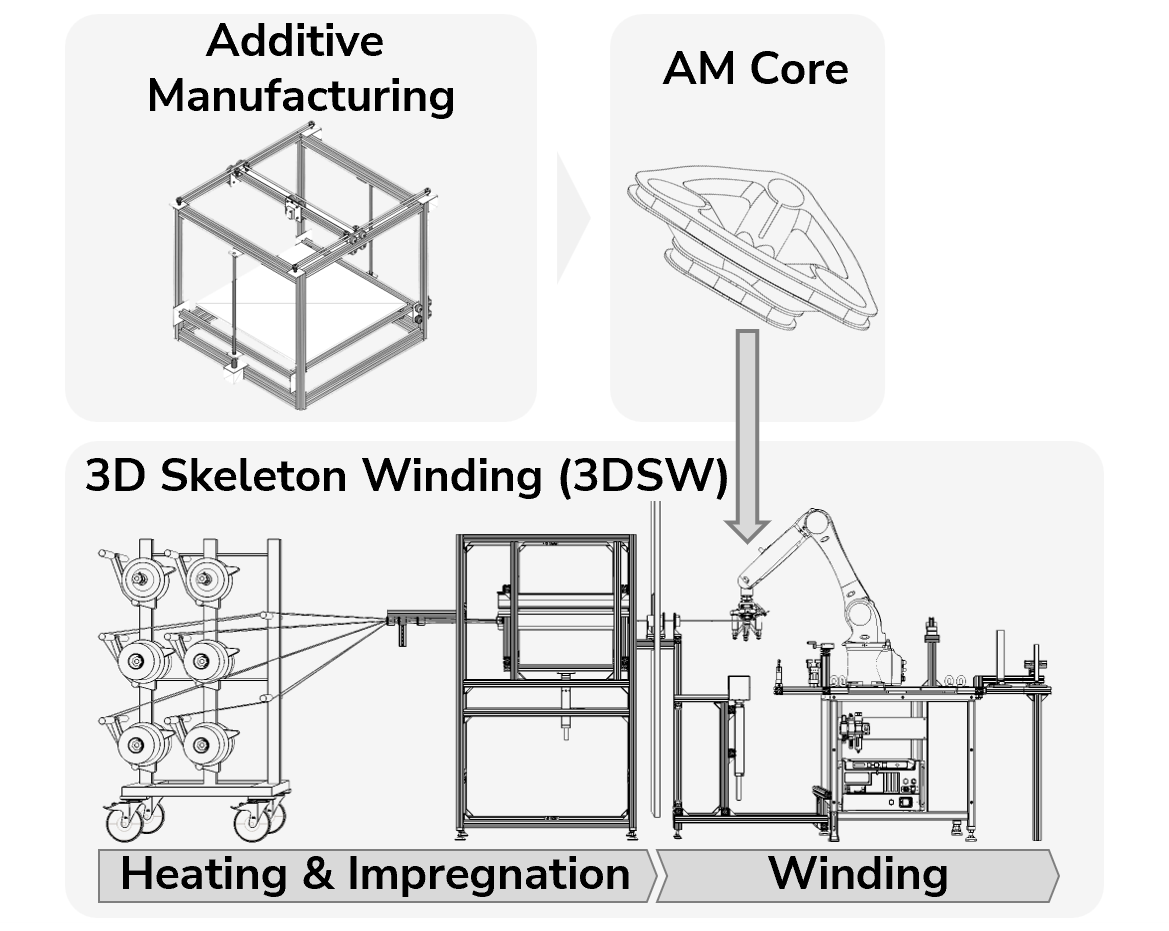
The confidentAM manufacturing concept combines a 3D-printed thermoplastic core with continuous fiber reinforcement. Additive Manufacturing creates the component shape, interfaces, and local functional details without a dedicated mold. The printed core also provides the support geometry required for the subsequent winding process.

In the winding step, continuous fiber-reinforced thermoplastic yarns are wound by a robot onto the 3D-printed core. The yarns are guided along the main load paths instead of covering the full surface area. During winding, the commingled yarns are heated, and consolidated, bonding the fiber skeleton to the core and forming an integrated thermoplastic hybrid structure.

The process combines the mold-free shaping capability of AM with the structural efficiency of continuous fibers. This enables lightweight, load-adapted composite parts for prototypes, small series, and application-specific industrial components without conventional tooling.

Schematic illustration of the process chain.

Schematic illustration of the process chain.

Virtual Design: From Load Cases to Optimized Structures

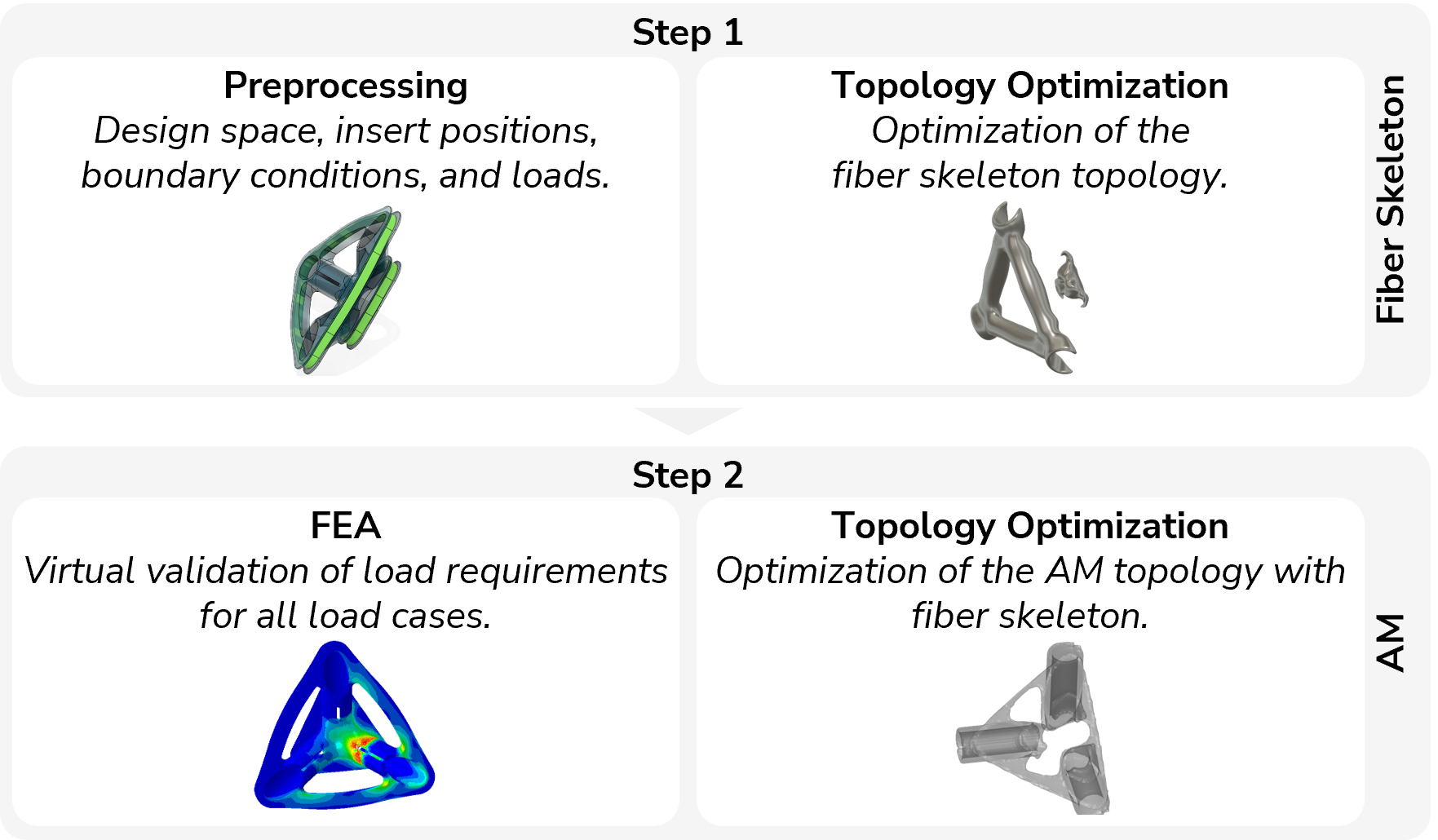
Step 1: Fiber skeleton definition. The workflow starts with preprocessing: design space, interfaces, insert positions, boundary conditions, load cases, material data, and manufacturing constraints are defined. Based on these inputs, topology optimization is used to identify the load-path-oriented fiber skeleton. The resulting fiber path is then fixed as the structural backbone for the subsequent core optimization.

Step 2: AM core optimization. The 3D-printed core is then optimized around the frozen fiber skeleton. Topology optimization is used to improve the core layout, while finite element analysis verifies stiffness, stress, deformation, and failure behavior across all relevant load cases. This loop is repeated until the lightweighting target, load requirements, and manufacturing constraints are met.

The output is a validated design concept including fiber paths, optimized core geometry, critical load-case assessment, and the basis for manufacturing planning. This reduces physical trial-and-error, identifies lightweighting potential early, and provides engineering confidence before the first demonstrator is built.

Schematic illustration of the virtual design and optimization approach for AM + 3DSW structures.

Schematic illustration of the virtual design and optimization approach for AM + 3DSW structures.

Process Simulation: Thermal Analysis of the Winding Process

For reliable 3D Skeleton Winding, the thermal process window must be controlled precisely. The commingled yarn enters the process at room temperature and has to be heated, impregnated, and consolidated before it reaches the printed core. If the yarn is underheated, bonding and interface strength are limited. If it is overheated, polymer degradation can occur.

Therefore, Simutence extended SimuQuick to analyze this winding process in real-time. SimuQuick is an online application designed for simulation laymen, enabling intuitive setup of process models. The model predicts the transient yarn temperature from pull-in at room temperature until the yarn reaches the required processing temperature at the core. Relevant heat sources are considered, including infrared heaters, microwave heating, and the heated consolidation nozzle.

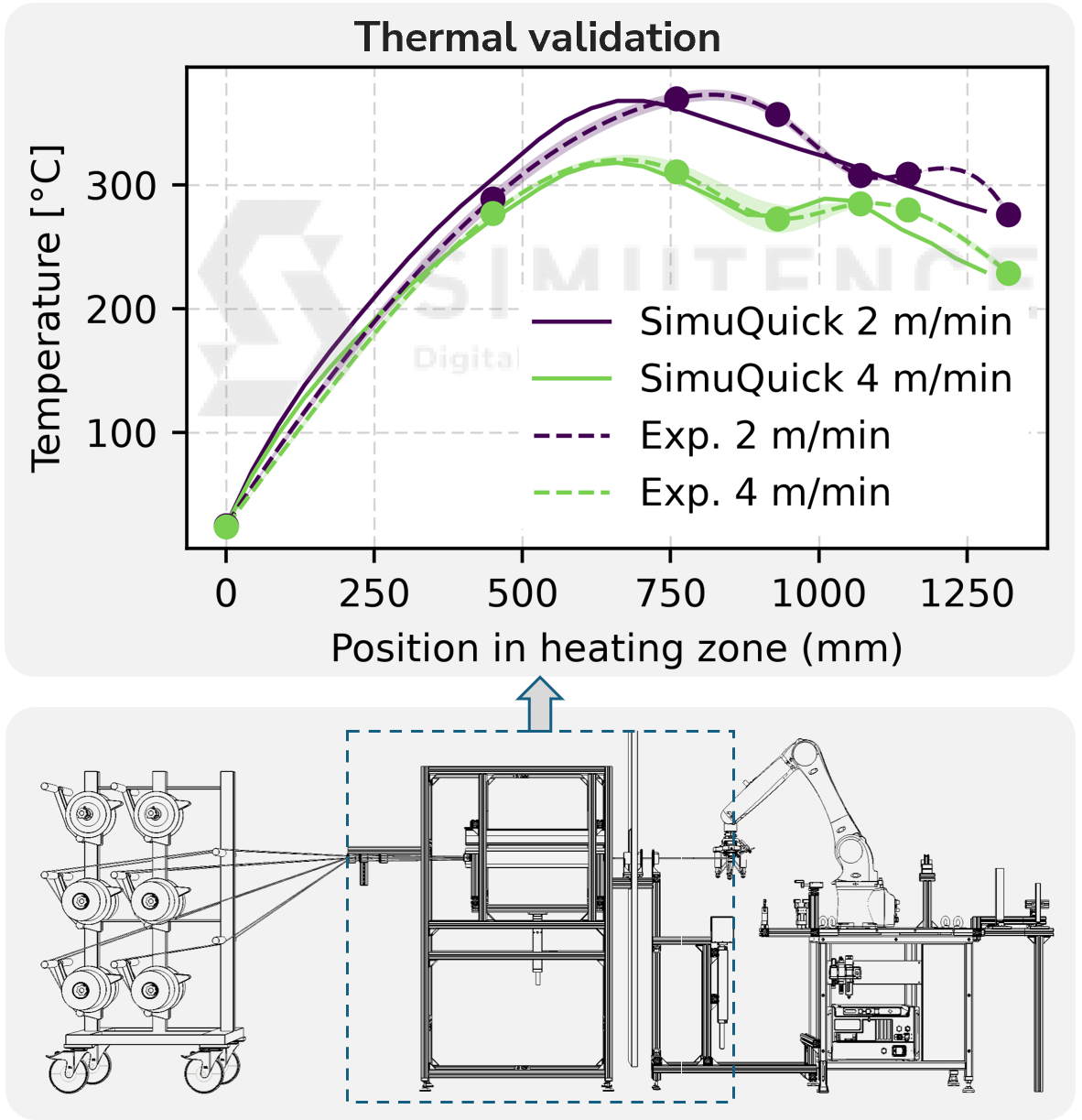
Validation trials showed high prediction accuracy for the simulated yarn temperature. The result supports fast assessment of heating strategies, process windows, and cycle times before manufacturing trials are performed. The winding analysis will become part of one of the next SimuQuick releases as an online application and can be accessed through a SimuQuick license. Pre-release access can be granted upon request for selected use cases.

SimuQuick thermal validation: Predicted vs. measured temperature along the heating zone.

SimuQuick thermal validation: Predicted vs. measured temperature along the heating zone.

Demonstrator: Modular Lightweight Gripper System

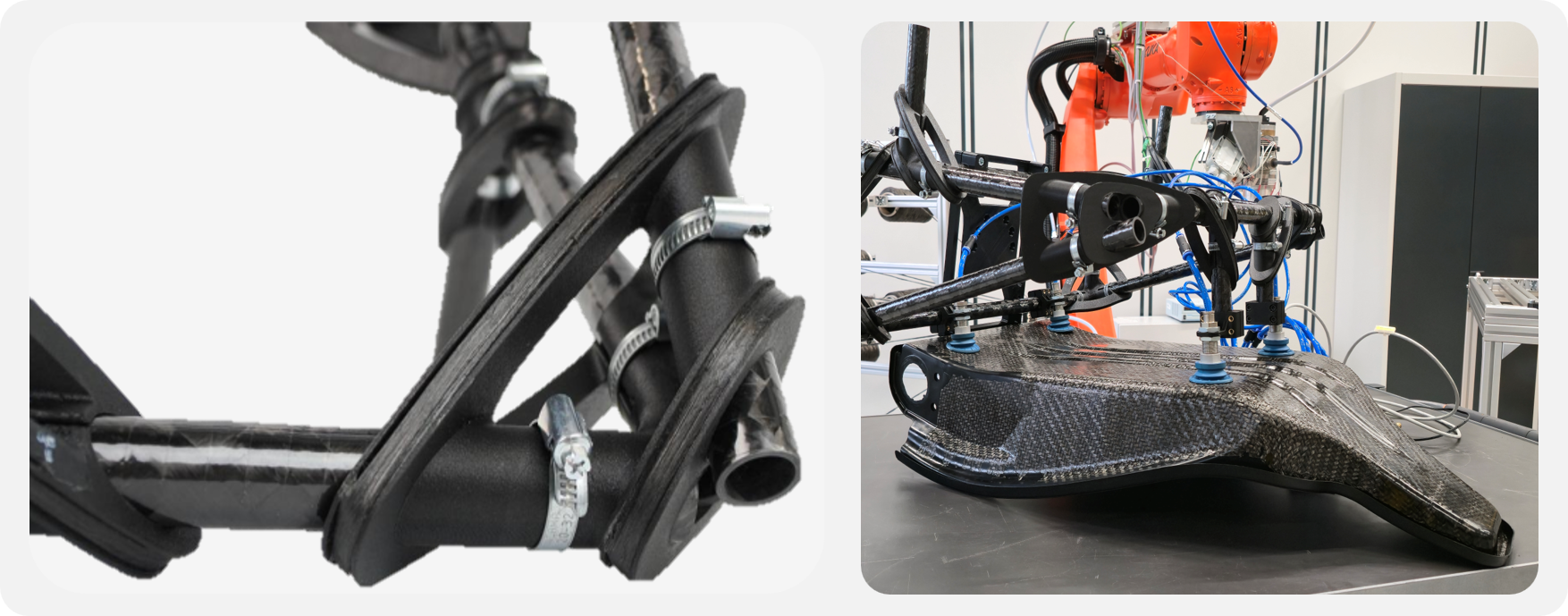
The first industrial demonstrator was a modular gripper system for molding processes, developed to show the applicability of AM + 3DSW in automation equipment. The gripper elements were successfully manufactured and assembled into a functional system with a maximum payload of 4.5 kg.

Compared to the metallic reference, the system mass was reduced from 9.45 kg to 2.92 kg, corresponding to a 69% weight reduction. This enables the use of smaller robot systems and reduces the moving mass in automated handling applications. Lower moving mass reduces required drive forces, enables higher process speeds, and decreases energy consumption and component wear.

The modular design also supports reusable gripper elements that can be assembled, disassembled, and reconfigured for different setups. In addition to the lightweighting benefit, the demonstrator achieved a 17% lower CO2 footprint compared to the reference design.

Modular lightweight gripper system.

Modular lightweight gripper system.

Demonstrator: Thermoplastic E-MTB Damper Rocker

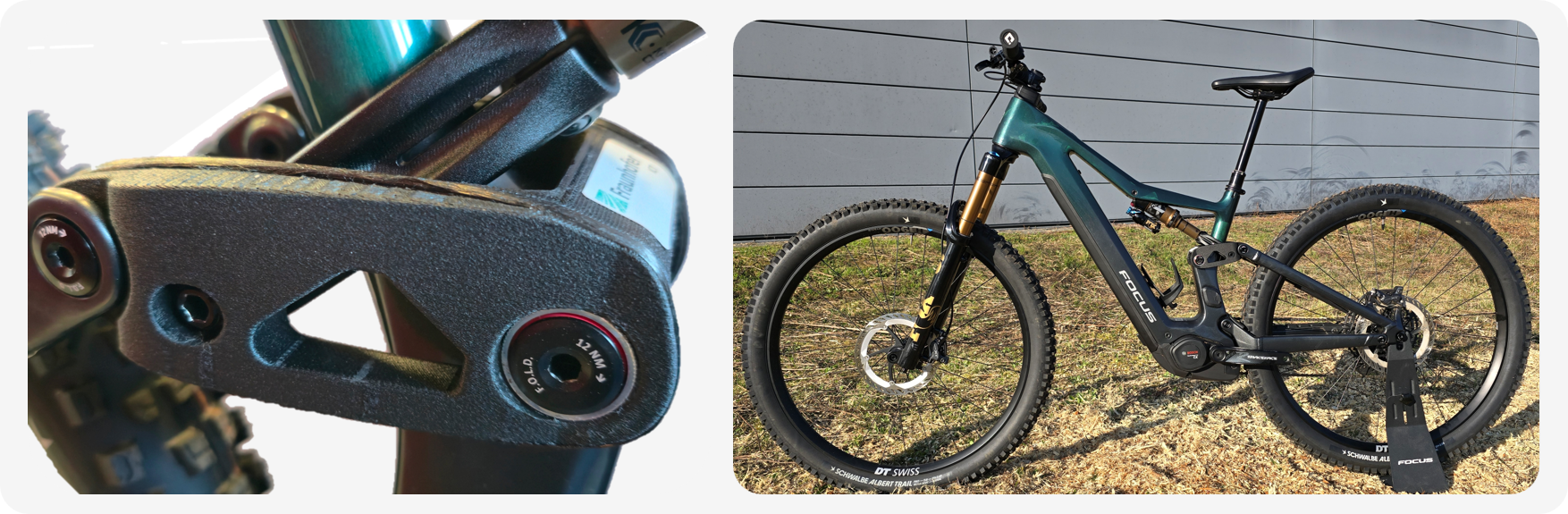
The second demonstrator was a damper rocker for a Focus E-Mountainbike, representing a highly loaded mobility component with complex load paths and limited installation space. The application requires high stiffness and strength under cyclic loading while maintaining low weight, making it a suitable benchmark for load-adapted thermoplastic composite structures.

The component was realized as a fully thermoplastic hybrid structure, combining a 3D-printed core with continuous fiber reinforcement. The fiber architecture was aligned with the dominant load paths, enabling efficient material usage while maintaining the geometric flexibility required for integration into the bike assembly. The demonstrator was successfully manufactured and applied to the bike system.

Compared to the reference design, the demonstrator reduced the component mass from 224 g to 153 g, corresponding to a 30% weight reduction. The thermoplastic material system enables recyclability and circular material concepts, while the lifecycle assessment showed a 20% lower CO2 footprint compared to the aluminum reference.

Thermoplastic E-MTB damper rocker.

Thermoplastic E-MTB damper rocker.

Conclusion: From Demonstrator to Application

The confidentAM project showed that AM + 3DSW can be used to design, manufacture, and validate lightweight thermoplastic composite structures for industrial applications. The modular gripper system and E-MTB damper rocker demonstrate that the approach is not limited to concept studies, but can be applied to functional components with measurable weight and CO2 benefits.

Simutence supported the technology development with a virtual engineering workflow covering load-path-oriented design, structural optimization, finite element validation, and process simulation. For companies evaluating lightweight thermoplastic composite structures, Simutence offers design and simulation services as well as access to dedicated simulation workflows such as the upcoming SimuQuick winding analysis through a SimuQuick license.

Acknowledgments

We gratefully acknowledge the funding of the confidentAM project by the Federal Ministry for Economic Affairs and Climate Action (BMWK).

Any questions?

Do not hesitate to get in contact with us if you have any questions or if you are interested in a collaboration. We are pleased if you leave us a message!